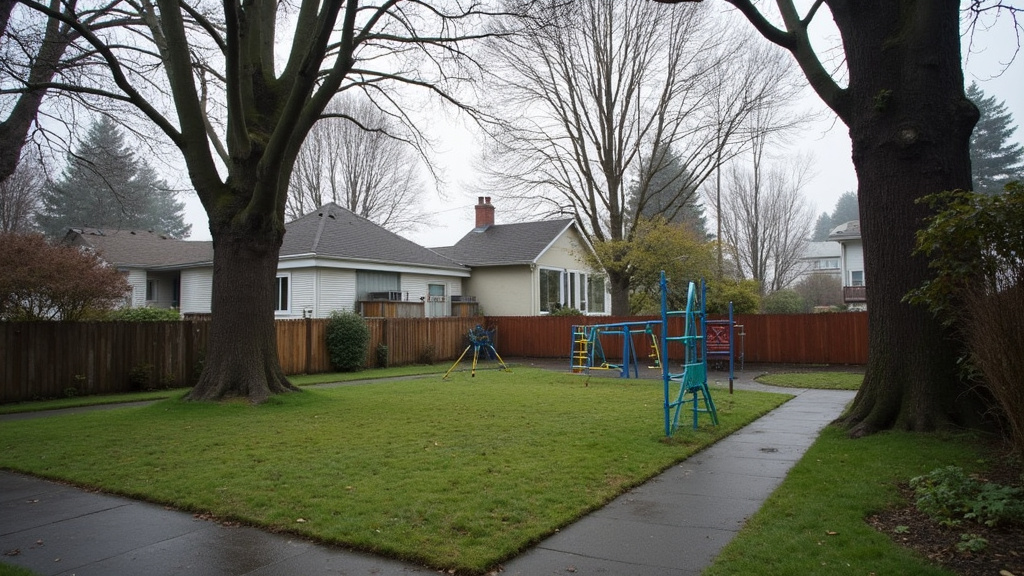
Emma Yule Park occupies a block at 4817 Rucker Avenue, tucked into the grid between Forest Park and the Evergreen Way commercial strip. It is small. There is a playground, grass, and a stand of mature trees that have been there longer than most of the houses around them. Nobody drives across town to visit it, which is exactly the point: it serves the three or four streets that can walk to it, and it has done that job for decades.
The park sits inside one of Everett's older residential pockets, a stretch the city bounds with 41st Street and Mukilteo Boulevard at the top, Evergreen Way on the east, Pecks Drive and 52nd Street along the bottom, and Pigeon Creek Number One down the western side. A creek for a boundary tells you something about the terrain. The streets on the slope stay quiet and residential, the flat edge turns commercial, and the line between them has been in roughly the same place for a long time.
Streets That Were Laid Out Before the Cars Got Big
Rucker, Alger, Fowler, Federal, Colby and Grand all run north to south through this area, and the cross streets climb in numbers from the forties into the fifties. The houses are mostly prewar and immediately postwar: bungalows, a run of Cape Cods, four square plans on narrow lots, detached garages reached down a single track driveway. Plenty have been added to, and the additions are visible from the sidewalk if you know what to look for.
Forest Park is two minutes away and takes most of the attention in this part of the city. The Interurban Trail runs down the western side. Madison Elementary and View Ridge Elementary sit at the edges of the neighbourhood map. What Emma Yule Park has instead of scale is proximity, which for a family with a four year old is the more useful quality.
What Is Actually Behind the Plaster
Housing stock this old carries its electrical history inside the walls. A house built in the 1920s or 1930s around here was wired for lighting and very little else, and then it was modified. Sometimes well. Sometimes by an owner in 1974 with a weekend and a roll of cable.
The findings that come up repeatedly in houses of this age:
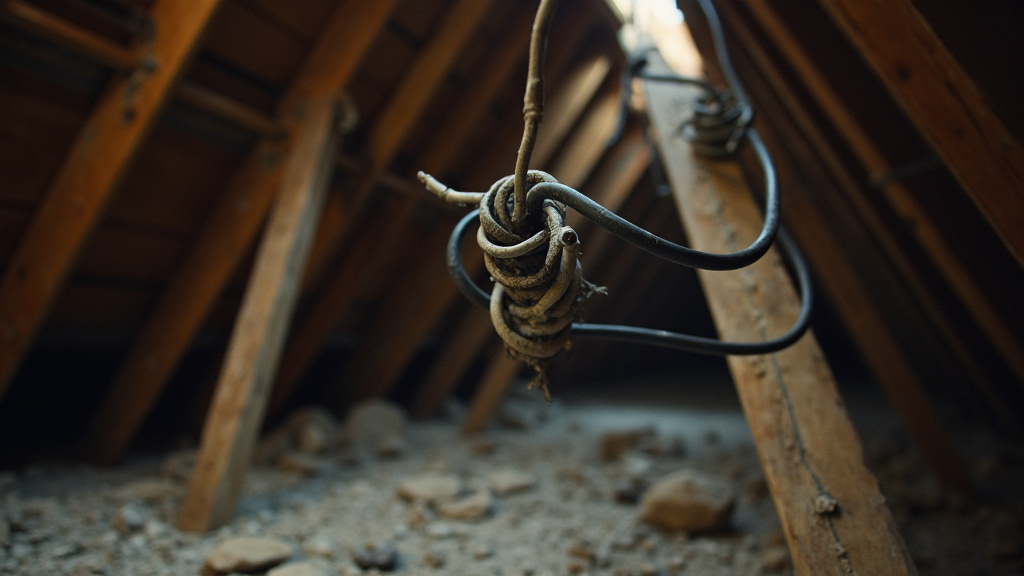
- Knob and tube in the attic and the exterior walls, often still live, often buried under later insulation that it was never designed to sit against.
- Two wire circuits with no ground, which is why the receptacles have two slots and why anything with a three prong plug has met an adapter.
- A panel that was upgraded once, decades ago, to a size that looked generous then.
- Cloth insulation that has gone brittle at the terminations, which is where it matters.
- Three or four separate eras of work spliced together in the same junction box.
None of that means a house is unsafe today. It does mean the honest answer to "can I just add a circuit for the garage" is sometimes no, or at least not without opening up what is already there.
When Rewiring Becomes the Cheaper Option
Whole house rewiring has a reputation as the nuclear option, and for a lot of houses it is the wrong call. The threshold is usually reached by accumulation rather than by a single discovery. Three or four separate repairs quoted in the same year. A renovation that opens walls anyway. Insurance asking questions about knob and tube. A new heat pump, an induction range and a car charger landing in the same twelve months on a service that was sized for a 1935 household.
When it does make sense, the practical realities are worth knowing in advance. Access drives the cost more than the wire does, so an unfinished basement and a walkable attic are worth real money. Plaster and lath is harder and messier than drywall. A house done in stages, one floor or one circuit group at a time, is normal and often the only way a family can live through it. Permits and inspection apply, and that is a feature rather than an obstacle.
It is also a job that frequently runs into plumbing. Old pipework and old wiring share the same joist bays, the same chases, and the same previous owner who made a decision in 1974. The Danika Plumbing & Electric Adds Licensed Electricians to Its Everett, WA Plumbing Team announcement describes one Everett company that brought electrical work under the same roof as its pipework for roughly that reason. Opening a wall once is better than opening it twice.
Water and wiring collide outside the house as well, which is its own project. If the ground around a foundation stays wet through the winter, it is worth understanding what shapes the cost of a drainage trench around here before anyone starts digging, and how a backyard drainage project actually goes in, step by step. On a slope above a creek, those two conversations tend to arrive together.
From the Playground on Rucker Avenue to Airport Road
Emma Yule Park is a few blocks east of Forest Park, and the office on Airport Road is south of both, out past the Evergreen Way corridor. The map below runs the route from the playground.
Danika Plumbing & Electric, 11015 Airport Rd, Everett, WA 98204. The office line is (425) 374-1557.
Small parks survive because the streets around them stay residential, and the streets around this one have stayed residential for close to a century. The houses have kept their shape and quietly changed everything inside. Most of them are now running a 2026 household on a wiring plan that predates the dishwasher, and that gap is the thing worth measuring before it announces itself.